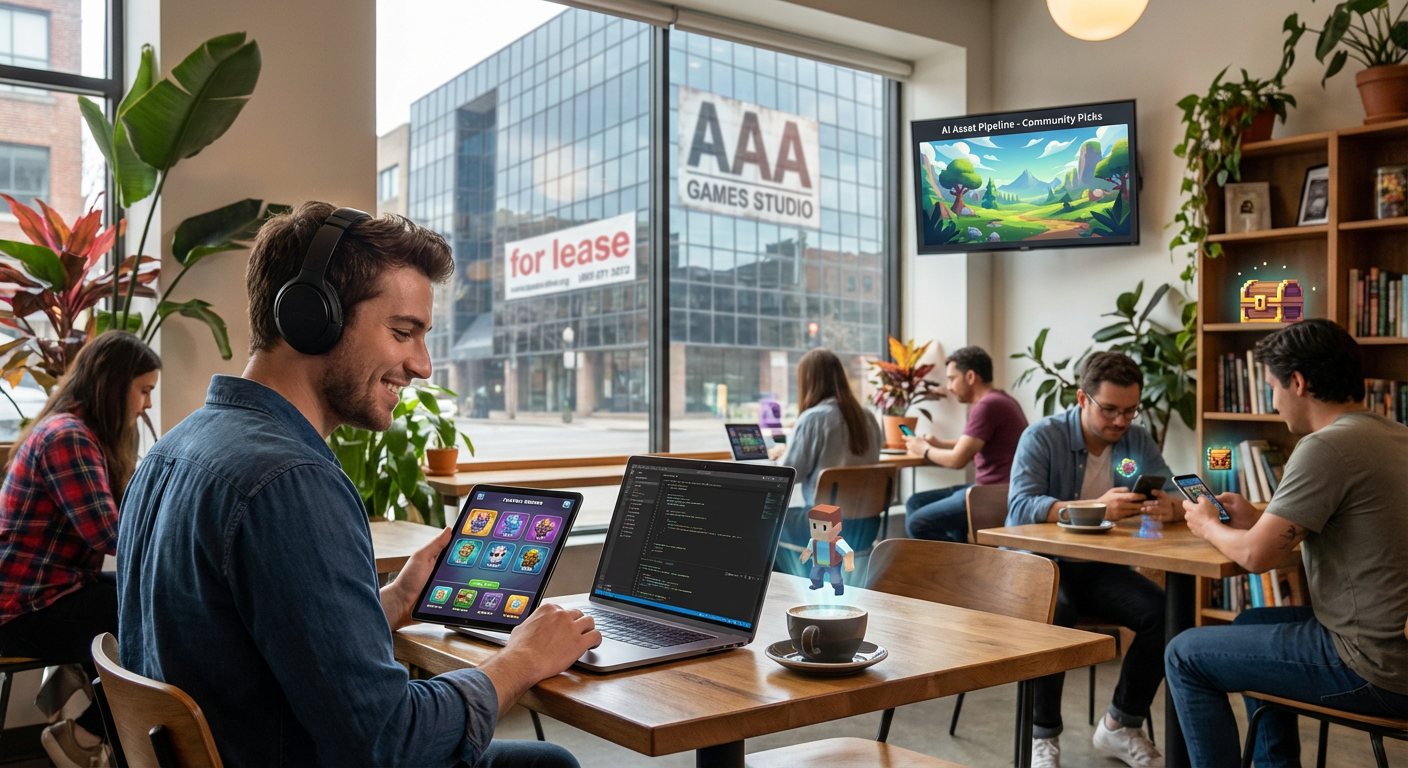
AAA Studios Burn, Indies Thrive on AI
The fallout on the European video game development scene was swift and completely public. Earlier this month, a senior developer for the highly anticipated *Kingdom Come: Deliverance II* was terminated, immediately taking to industry forums to claim they were replaced by automated systems. Days later, Pearl Abyss, the studio behind the sprawling RPG *Crimson Desert*, pushed an emergency patch to quietly scrub controversial machine-generated art from its live environment following immense player backlash.
Major studios are officially panicking. Activision confirms its own ongoing experiments with automated workflows and platforms like Steam revise their disclosure guidelines. The narrative around AI in gaming has turned overwhelmingly hostile. Players are rejecting massive, bloated titles that feel mathematically hollowed out in an effort to save overhead costs.
Yet, this AAA meltdown conceals a significant shift in mobile gaming history. While legacy studios are getting publicly burned for trying to replace human artists with algorithms to cut costs, independent developers are utilizing the exact same technology to break into the booming $3.2 billion skill-based gaming sector. The difference lies entirely in execution, intent, and a fundamental understanding of what modern players actually want to pay for.
The Economics of the Indie Boom
The gap between a massive studio cutting corners and a solo developer scaling an empire comes down to focus. In the AAA space, AI generated game assets are increasingly viewed as a mechanism to eliminate payroll. For the independent developer, they are an infrastructural springboard that reclaims hundreds of hours of production time.
When a solo creator begins researching how to make a puzzle game online, the traditional roadblock has always been the sheer volume of visual production required to launch a viable minimum product. Today, an aspiring developer might use a free AI game asset generator for 48 hours to quickly block out UI elements, card backs, and background art. But that is where the automation stops, and the actual game design begins.

By leveraging AI generated game assets strictly for rapid prototyping and visual scaffolding, nimble developers are suddenly free to dedicate their entire production budget to the unseen architecture that actually monetizes a mobile title: the mathematics, the tournament economy, and the matchmaking engine.
As displaced AAA talent floods the indie market, they are realizing that mobile gaming dominance no longer requires a twenty-person art department. It requires a flawless gameplay loop where every single match feels genuinely earned.
"Play For Real" - The New Imperative
To understand why independent developers are capturing so much market share, consider the psychological shift in how mobile audiences approach their screens in 2026. Players are utterly exhausted by deceptive algorithms, pay-to-win mechanics, and games that feel like endless treadmills designed to extract cash. They are aggressively migrating toward titles that respect their time and their intelligence.
This demand for authenticity is beautifully encapsulated by Papaya Gaming's "Play For Real" philosophy. Modern players show up with presence and sincerity, and they demand digital arenas that mirror those values. They want to test themselves, grow, and experience genuine challenges against real human opponents.
When a developer uses automation efficiently on the backend, they can spend their real energy building these fair, competitive arenas. Take Papaya's defining titles like Solitaire Cash. The success of this platform isn't predicated on rendering the most complex 3D graphics imaginable; it is built on airtight, skill-based mechanics where every player receives the exact same deck. The matchmaking algorithms act like highly sophisticated sporting directors, ensuring that human competition remains the primary focus.
This is why the scandal surrounding AI generated game assets in AAA titles feels so disconnected from the reality of mobile development. Players aren't inherently angry about technology; they are angry at being cheated out of a genuine, high-effort experience. When indie developers use these tools to unleash their potential through play environments that actually reward human skill, the market responds with incredible retention and revenue.
Designing the Competitive Future
The cultural weirdness of the moment reached a new peak recently with *Pragmata*. The development team intentionally designed a New York City level to look like a bizarre, glitchy AI hallucination—despite the entire stage being painstakingly crafted by human hands. It was a meta-commentary on an industry losing its grip on reality.
Independent mobile developers don't have the luxury of multi-year meta-jokes. They operate in a hyper-competitive, results-driven market where fairness is the ultimate growth hack. Mastering competitive logic puzzle game design online means understanding that a beautiful, AI-assisted interface is entirely worthless if the core game relies on chance rather than skill.

Players want to know that if they practice, if they focus, and if they apply themselves, they will win. This requires incredibly tight game mechanics. The developers currently achieving massive financial returns are those utilizing every tool available—from a free AI game asset generator to complex data analytics—to build fair ladders. They are proving that fair matchmaking is gaming's biggest growth hack, and they are securing market shares that established studios can only dream of.
The Golden Age of Indie Agility
The current crisis in the AAA industry is not a warning sign for gaming; it shines a massive, flashing green light for independent creators. Big studios are trapped in a cycle of generating bloated assets, sparking player outrage, and issuing public apologies. Meanwhile, solo developers and small teams are shipping polished, competitive titles faster than ever before.
Never before has the barrier to entry been so democratized, and never has the demand for pure, unadulterated human skill been so strong. For developers who prioritize fair play, who refuse to hide behind pay-to-win exploitation, and who respect the player's desire to truly compete, the current technological landscape is a genuine gold rush.
The integration of AI generated game assets will continue to evolve, but it will settle precisely where it belongs in the independent scene: as a silent, powerful utility accelerating early production. The true value, and the true future of the industry, lies in the human capacity to connect, compete, and play for real. For independent developers looking to break into this booming ecosystem, platforms dedicated to skill-based excellence are already actively publishing the next generation of competitive hits, helping turn small teams into industry heavyweights almost overnight. Will you be next?
Frequently Asked Questions
Ready to turn your game into a competitive tournament?
Partner with Papaya to bring skill-based competition to your players.
Partner with Papaya